Qualitative and Quantitative Research & Analysis
Design Ethnography
“Ethnography is a research methodology developed and used in various social sciences, such as anthropology and sociology. Its literal meaning is ‘description of people’.” The ethnography research methods include participant observation, interaction, conversation and co-creation with the users. Design ethnography informs and inspires design processes and offers references about people’s everyday life; their practices, motivations, dreams and concerns.
All of my Design projects involve Design ethnography. Depending on the scope of the project, the research phase and the number of participants in the ethnography research varied from three to one hundreds people. I mostly used observation and interview to collect data. When possible, group discussion was another method used.

Interview with small business owners 
Interview with entrepreneurs
The process of research starts with planning and writing the research guide. Usually, this was a collaborative work between my team and the partner’s team to be aligned on the research direction and expected results. Often, I was the research lead which means I was responsible to create the initial draft for the research plan and research guide and revise them after receiving feedback from the team and the partners. I also drafted the research questions for many projects.
Some research were done in person and some through phone or video calls. We would record the interview with the interviewee’s consent unless the topic was sensitive. Within the interview team, we had different roles such as interview lead who would ask the pre-determined questions and the note taker. The notes were usually documented in a Word file and were transferred into digital sticky notes for synthesis.
For understanding the collected data, synthesis, we would group the data in clusters based on their relationship to each other and the goal of the research. From there, we would create insights and develop understanding about the findings. These processes can take months depending on the number of interviewees. I was often the synthesis lead, preparing the synthesis framework and facilitating the process. The below image shows data and synthesis for a project with 20 interviewees which I led.

Qualitative Analysis for Quantitative Direction
In some projects, partners had collected massive data through surveys or previous projects. I was responsible to show, how we can use the existing data to discover and show a relevant finding or where to focus the statistical analysis on. Most of this work was intuitive and required understanding connections and creating thinking.
The two examples of these types of work were a project with National Archive for improving the Customer Experience and the Telehealth projects with HHS, for improving the patients experience.
Qualitative Research Publications
- Making a More Inclusive Future of Work, Source America report, 2020.
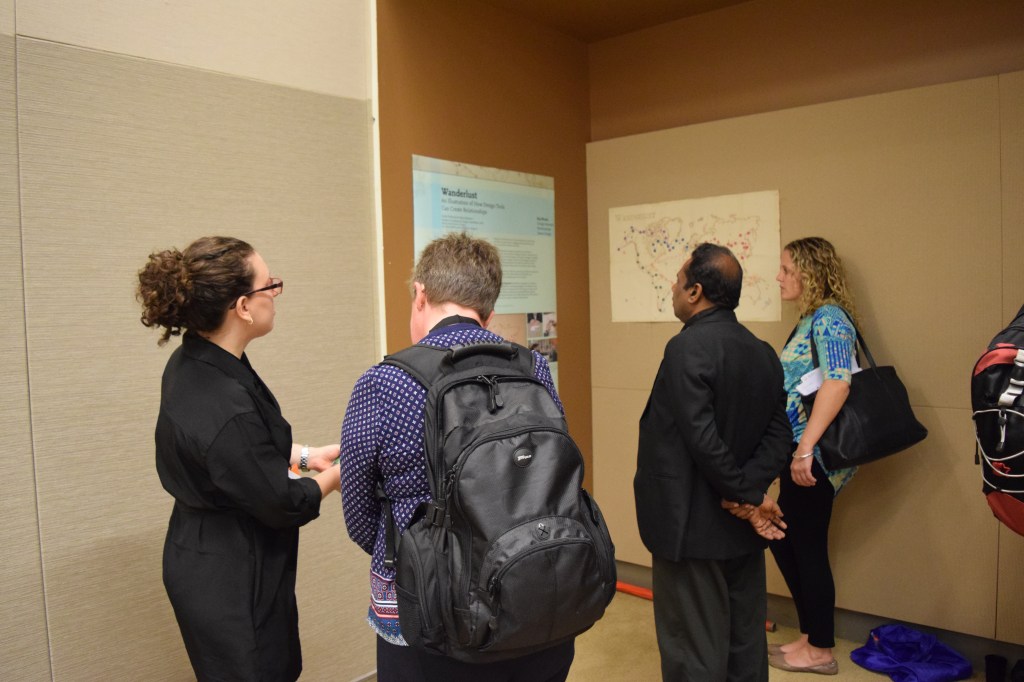
- “Wanderlust: An Illustration of How Design Tools Can Create Relationships” Conference poster, 2015 Aging and Society Conference at Edward J. Pryzbyla University Center Washington D.C, USA./ Second author.
* Dr. Geke van Dijk, Strategy Director STBY London & Amsterda
Quantitative Research Methods and Analysis
Given that my undergraduate degree is physics, for over three years, I worked at a Harvard affiliated hospital (BIDMC) as a research assistant. My focus was Neuromuscular disease. We partnered with local research labs at Harvard Medical School and Massachusetts Institute of Technology. Our research usually started with drafting the research plan and determining the hypothesis which we were going to evaluate during the course of study. We had specific requirements for the number of participants, study subjects or data samples. I used Matlab and R for statistical analysis on data and both of these programs have ready pre-made libraries which facilitate the process of coding.
Quantitative Publications
- “Distinguishing neuromuscular disorders based on the passive electrical material properties of muscle” Muscle & nerve, 51: 49–55, 2015/ Second author.
- “Optimizing Electrode Configuration for Electrical Impedance Measurements of Muscle via the Finite Element Method”, IEEE Transactions on Biomedical Engineering, 10.1109, 2013/ First author.
- “Assessing Electrical Impedance Alterations in Spinal Muscular Atrophy via the Finite Element Method”, Annual International Conference of IEEE Engineering in Medicine and Biology Society. 08/2011; 2011:1871-4. DOI:10.1109/IEMBS.2011.6090531 / First Author
“Assessment of Alterations in the Electrical Impedance of Muscle after Experimental Nerve Injury via Finite-Element Analysis”, IEEE Trans. Biomed. Engineering 58(6): 1585-1591, 2011.
 Embracive Design